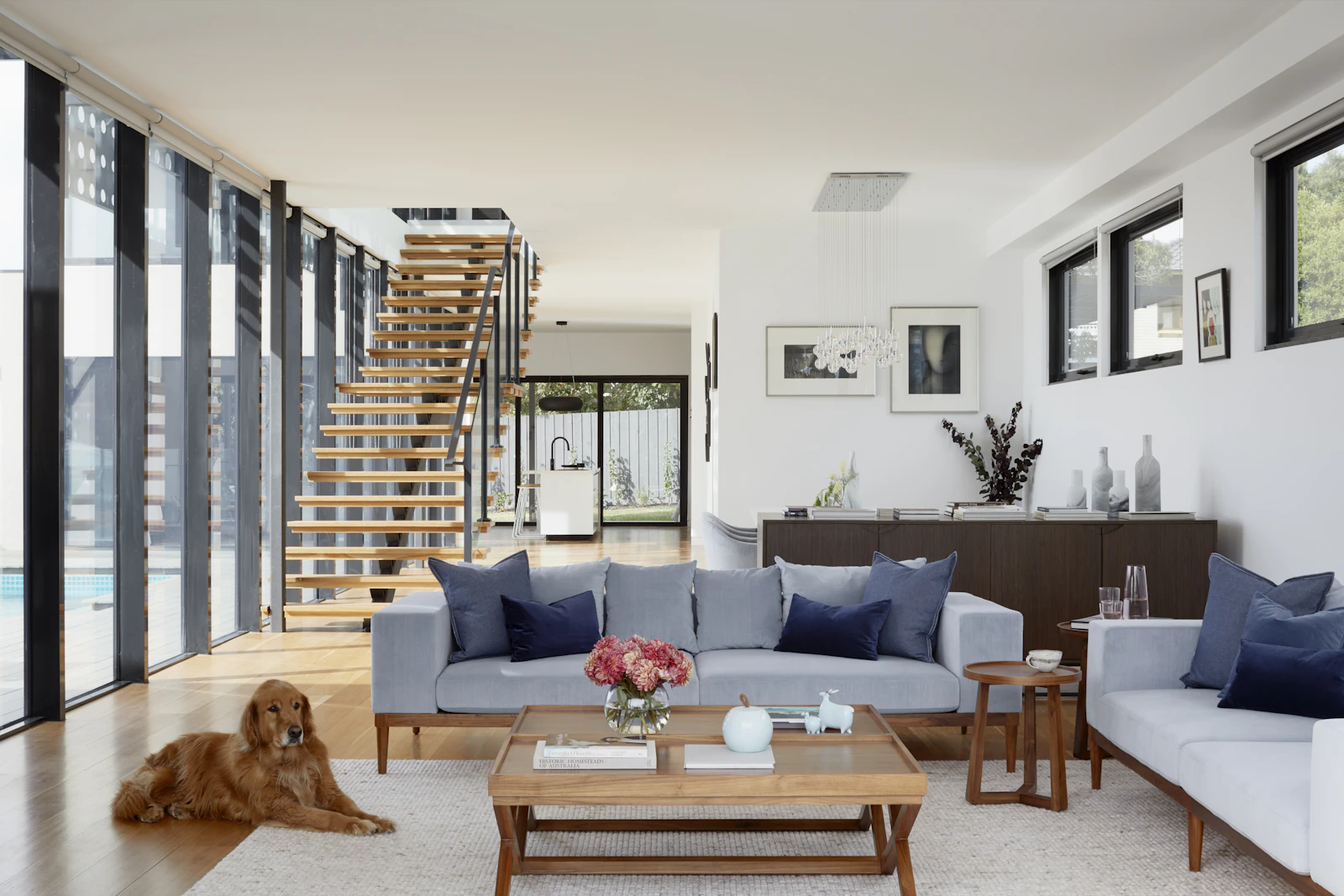
Rug sizing rules sound fussy until you realize most rugs fail for one reason: they are too small. Shoppers measure the coffee table instead of the seating group, bring home a tidy little rectangle, and watch it float alone like a placemat in the middle of the room. These placement rules fix that mistake room by room — living room layouts, bedroom drops, dining clearance, entries, and care for homes with kids and pets.
The One Rule: Anchor the Furniture, Not the Floor
A rug should connect the pieces people actually use together. In practice, that means front legs of sofas and chairs sit on the rug, walkways stay on bare floor or a runner, and at least 20 to 30 cm of hard floor shows around the edges so the room can breathe. When every key seat touches the same rug, the eye reads one conversation zone instead of five separate items.
- Front-legs-on: the safest default. Sofa and armchair front legs rest 15 to 20 cm onto the rug; back legs stay off.
- All-legs-on: best for large open rooms where seating floats mid-floor with space behind it.
- Coffee-table-only: avoid this. A rug that holds only the table looks like a placemat and shrinks the room.
- Tape it first: outline the candidate size on the floor with painter's tape, live with it a day, then order.
- Leave a border: keep 20 to 30 cm of visible floor between rug edge and wall in average rooms, 45 cm in grand ones.
Before ordering, measure the full seating footprint with chairs pulled out as if someone were sitting down. That footprint plus 20 cm on each side is your minimum rug width. Length follows the same logic. One generous rug always looks calmer than two small ones trying to cover the same group.
Living Room Rug Sizing That Actually Works
The living room is where size mistakes show most. A three-seat sofa with two chairs needs more rug than most people expect: 200 by 300 cm is the everyday sweet spot, and open-plan rooms often need 250 by 350 cm or larger. Match the rug to the arrangement, not the room's square footage. A compact apartment with a floating two-seat setup can look settled on 160 by 230 cm, while a sprawling family sectional swallows anything under 200 by 300 cm.
| Seating Setup | Go-To Rug Size | Placement | Avoid |
|---|---|---|---|
| Sofa plus two chairs | 200 x 300 cm | Front legs on, coffee table centered | 160 x 230 cm island rug |
| L-shape sectional | 250 x 350 cm | Whole chaise section on rug | Rug ending mid-chaise |
| Small apartment, loveseat | 160 x 230 cm | Front legs on, rug under table | 120 x 170 cm mat |
| Floating open-plan zone | 250 x 350 cm or larger | All legs on to define zone | Two small rugs side by side |
| Fireplace facing pair | 200 x 300 cm | Rug spans both chairs evenly | Rug touching hearth edge |
Center the rug on the main anchor — usually the sofa or fireplace — not on the room's midpoint. In long rooms, the rug should run parallel to the longest sofa. If your living room doubles as a display wall, coordinate rug tone with the frames using these small showcase designs for living room walls so floor and wall share one palette instead of competing.

Bedroom Rug Placement for Soft Mornings
Bedrooms need softness where feet land, not necessarily under the whole bed. The classic move is a large rug tucked two-thirds under the bed and extending 60 to 80 cm past the sides and foot, so both sleepers step onto warmth. For a queen bed that usually means 200 by 300 cm; for a king, step up to 250 by 300 cm or larger. Push the rug far enough under the bed that nightstands can sit half on it or fully off it — never wobbling with one leg on and three off.
Small rooms have a simpler option: two runners, one along each side of the bed, each at least 70 cm wide and as long as the bed plus 30 cm. Runners suit tight layouts where a full rug would bunch against wardrobes or doors. Keep the runner 10 cm clear of the nightstand base so vacuuming stays easy. Whatever you choose, low pile wins near beds; deep shag traps dust where you breathe all night and makes the bed skirt look sunken.
Dining Room Clearance: Chairs Stay on the Rug
Dining rugs have one job: keep chairs on fabric even when pulled out. Measure the table, then add at least 60 cm on every side — 75 cm is kinder for armchairs. A six-seat rectangular table around 90 by 180 cm therefore wants roughly 240 by 330 cm beneath it. Round tables follow the same math: a 120 cm round table with four chairs sits well on a 240 cm round rug or a 230 by 230 cm square.
Check chair glide before you commit. Pull every chair out as if someone were sitting down to eat; back legs should still rest on the rug with margin to spare. Thin, low-pile, stain-resistant weaves work hardest here — flatweave wool, washable cotton, or indoor-outdoor blends that hose down. Deep pile wobbles chairs and catches crumbs permanently. If your dining corner sits inside a busy family space, borrow durability ideas from our guide to family living room ideas for real life with kids and pets.
Entries, Kitchens, and Awkward Small Spaces
Small zones follow smaller math but the same anchoring logic. In an entry, the rug or runner should span nearly the full width of the door approach — at least 80 percent of the door width — and run long enough that two people can stand on it together. Leave the door swing clear: measure the arc and start the rug beyond it, or choose a low 5 mm pile that doors glide over.
In kitchens, runners belong where feet stand longest: along the sink counter and the cooker run, 60 to 80 cm wide with 10 cm clearance from cabinet kickboards. Avoid placing small mats at angles; one long washable runner reads calmer than three scattered rectangles. Hallways want continuous coverage too — one runner that spans 75 percent of the hall length beats two short pieces with a bare gap in the middle. Everywhere small, keep 5 to 10 cm of floor visible at edges so the runner looks laid, not wedged.

Material, Pile, and Care That Protect Your Choice
Size gets the attention, but material decides how the rug lives. Wool handles traffic gracefully, hides soil, and springs back under furniture dents; it suits living rooms and bedrooms that want long-term calm. Cotton flatweave and washable blends suit dining rooms, kitchens, and pet homes where spills are routine. Natural jute and sisal add texture but snag claws and scratch bare feet, so reserve them for low-traffic corners rather than play zones.
Protect the investment with a felt or rubber-backed pad cut 2 cm smaller than the rug on all sides. Pads stop creep on hard floors, add 5 mm of comfort, and extend rug life by years. Vacuum weekly without the beater bar on looped or natural weaves, rotate the rug 180 degrees each season to even out sun and traffic, and blot spills from the edge inward instead of rubbing. The Rug Institute offers plain-language guidance on rug care and cleaning basics if you want fiber-by-fiber instructions. Right size, honest material, simple care: that combination keeps floors quiet and rooms whole for a decade.
Priya Nair covers indoor greenery, plant styling, and light-first room planning for Interior Den. She keeps 30 plants alive in a north-facing apartment.
Join the discussion
Show us your rug layout or ask Priya a sizing question before you buy.